

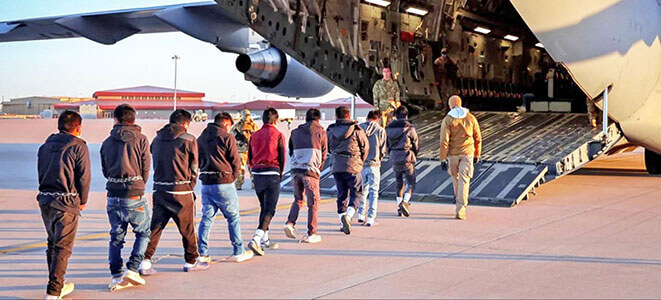
On 30th January 2026, Grenada and the United States signed a non-binding memorandum of understanding (MOU) providing for the potential transfer to Grenada of third-country nationals subject to removal from the United States.
Grenada had initially declined the US proposal, but agreed to the arrangement following repeated requests from the US government.
Under the MOU, the United States may propose persons for transfer, while Grenada retains discretion to accept or reject them on a case-by-case basis. Grenada may give preference to people whose skills or competencies could contribute to the country’s development.
Prime Minister Dickon Mitchell presented the arrangement as a potential means of addressing labour shortages, particularly in the construction, agriculture and hospitality sectors.
The MOU includes assurances that people transferred to Grenada will not be subjected to persecution or torture there or subsequently transferred to a country where they would face such treatment.
However, the Third Country Deportation Watch, a joint initiative of Human Rights First and Refugees International, has raised concerns about the risks associated with the agreement.
Grenada is not a party to the 1951 Refugee Convention or its 1967 Protocol and has no dedicated national legislation or formal procedure for refugee status determination.
Any refugee or asylum request goes through immigration regulations. Although the principle of non-refoulement remains binding on all states as a norm of customary international law, the absence of a domestic framework raises questions about how Grenada would identify and protect transferred people who fear persecution or torture.
As of 11th August 2026, no transfers to Grenada were known to have taken place under the agreement.
These concerns increased in July 2026, when leaders of the Caribbean Community (CARICOM), including Grenada, said the proposed arrangements would facilitate the transit of third-country nationals to their countries of origin rather than their settlement in Caribbean states.
Third Country Deportation Watch warned that onward removals could result in successive transfers that ultimately return a person to a country where they face persecution, torture or other serious harm.
Between January 2025 and mid-August 2026, the United States forcibly transferred over 23,000 people to 26 third countries, with some subjected to arbitrary detention, family separation, and other harms.